

Gifting assets during your lifetime has become a common strategy for reducing a potential Inheritance Tax (IHT) bill. Indeed, according to Paragon Bank (31 July 2025), 1 in 5 savers aged over 65 are passing on cash for this reason.
Yet, gifting doesn’t always mean that assets are excluded from your estate when calculating IHT, and there are a lot of misconceptions about when the tax could be applied.
Inheritance Tax may apply to your estate after you pass away
To understand if your gifts might be liable for IHT, you also need to be aware of how IHT works and when estates are liable.
IHT is a tax that’s applied to your estate after you pass away if the total value exceeds certain thresholds. The standard rate of IHT is 40%, so it could significantly reduce how much you leave behind for your loved ones.
Your estate includes your assets, such as property, savings, and investments. From April 2027, most pensions will be included in the value of your estate when assessing if IHT is due, so you might need to re-evaluate your estate’s liability with this reform in mind.
In 2026/27, there are two main IHT allowances:
- The nil-rate band, which is £325,000. If the value of your estate falls below this threshold, no IHT will be due.
- The residence nil-rate band, which is £175,000. You may use this allowance if you leave your main home to direct descendants. It will taper by £1 for every £2 that your estate’s value exceeds £2 million.
You can pass on unused allowances to your spouse or civil partner. As a result, you may be able to pass on up to £1 million before IHT is due if you’re planning as a couple.
Importantly, IHT is applied to the portion of your estate that exceeds the IHT thresholds.
So, if your estate could use both the nil-rate band and the residence nil-rate band, and was valued at £600,000, IHT would be due on the £100,000 that exceeds the thresholds. This would result in an IHT bill of £40,000.
Why gifting may not be a simple way to reduce your estate’s Inheritance Tax bill
If your estate could be liable for IHT, passing on your assets during your lifetime might seem like the obvious solution, but there are some complexities you need to be aware of.
First, keep in mind that your circumstances could change and gifts might not be recoverable if you need the assets in the future. It’s important to review gifts in the context of your wider financial plan to assess the impact they could have on your long-term financial security.
Second, not all gifts are immediately outside of your estate for IHT purposes. The following allowances may provide a way to pass on assets free of IHT:
- The annual exemption means you can give away up to £3,000 each tax year without the value being added to your estate. You can gift this sum to one person or split it between several people. You can carry forward unused annual exemptions for one tax year.
- You can also make small gifts of up to £250 per person each tax year, as long as you have not used another allowance on the same person.
- If you’re celebrating a wedding or civil partnership, you can take the opportunity to pass on £1,000 tax-efficiently. This allowance rises to £2,500 if it’s your grandchild or great-grandchild getting married, and to £5,000 for your children.
- Regular payments made to another person may be free from IHT. These gifts must be made from your regular income after meeting your usual living costs. They must also be given regularly. You might use this allowance to pay rent for your child, cover school fees, or add to a savings account on behalf of your grandchild. It’s important to keep an accurate record if you’re planning to use this allowance, as HMRC may look for an established pattern of giving.
Gifts that do not fall within these allowances will normally be considered potentially exempt transfers (PETs).
Inheritance Tax and potentially exempt transfers
PETs are gifts that might be considered part of your estate and could be liable for IHT.
If you live for seven years after passing on a PET, it will then fall outside of your estate for IHT purposes. So, gifting assets earlier in your life could make sense, but this should be balanced with assessing how it might affect your long-term finances, including if your needs change.
If you pass away within seven years of gifting a PET, IHT may be applied. The taper relief means the rate of IHT you pay on gifts falls as time passes. In 2026/27, the taper relief is:
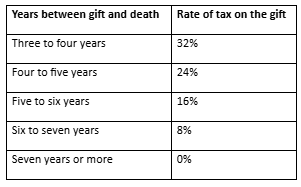

You should note that the taper relief only applies if the total value of gifts made in the seven years before you pass away exceeds the nil-rate band. As a result, if no tax is payable because the transfer does not exceed the nil-rate band, no relief can apply.
So, when assessing the potential IHT liability of gifts, you may also need to consider the wider value of your estate.
Get in touch
If you’d like to discuss your estate plan, including how you might pass on assets to your loved ones tax-efficiently, please contact us. There may be other strategies, alongside gifting, that could reduce your estate’s IHT bill.
Please note: This article is for general information only and does not constitute advice. The information is aimed at individuals only.
All information is correct at the time of writing and is subject to change in the future.
Please do not act based on anything you might read in this article. All contents are based on our understanding of HMRC legislation, which is subject to change.
The Financial Conduct Authority does not regulate Inheritance Tax planning or estate planning.